
Who Is Barabbas in the Bible? Why the Crowd Chose Him
Barabbas in the Bible was the notorious prisoner whom Pontius Pilate released instead of Jesus during the trial before the crucifixion. The Gospels describe him as a criminal tied to rebellion, murder, and robbery, which is why his brief appearance still matters so much: Barabbas walks free while Jesus is condemned.
That is the main reason Christians remember him. Barabbas does not stay in the story for long, but his release becomes one of the clearest Gospel pictures of guilt going free while the innocent Son of God suffers in that guilty person's place.
What do the Gospels say about Barabbas?
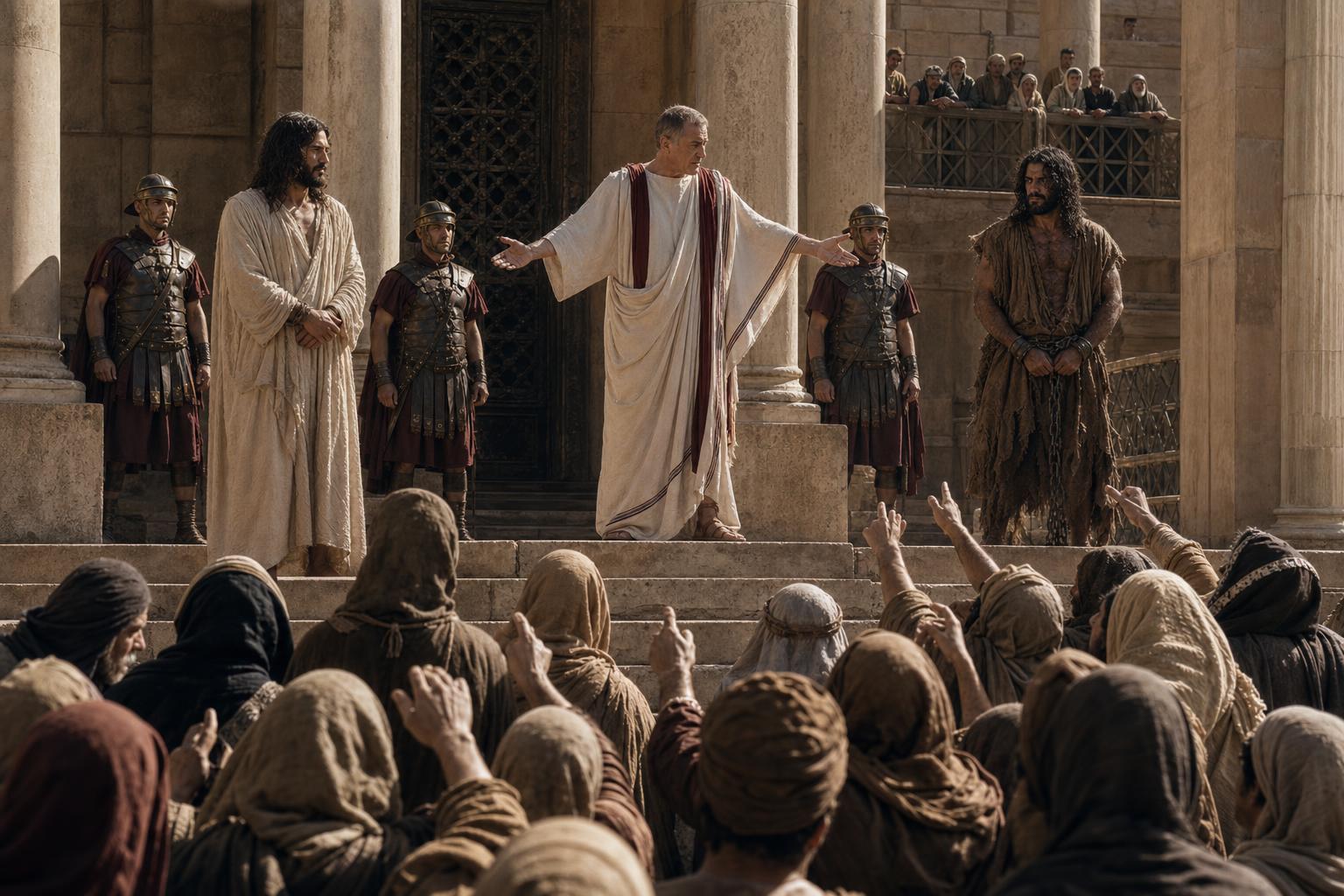
All four Gospels mention Barabbas in the same basic setting: Jesus is standing before Pilate, and the governor offers to release one prisoner to the crowd during the feast. Barabbas is the man the crowd chooses.
Matthew introduces him as a notorious or well-known prisoner (Matthew 27:16). Mark gives more detail and says Barabbas was in prison with rebels who had committed murder in the insurrection (Mark 15:7). Luke says he had been thrown into prison for rebellion in the city and for murder (Luke 23:19). John adds that Barabbas was a robber (John 18:40), and several modern translations make the same idea more explicit by using words like rebel or revolutionary.
Those descriptions are not really competing with each other. Matthew gives the reputation. Mark and Luke spell out the charges. John uses a shorter label that still points to a violent criminal, not a harmless thief. Put together, the Gospel picture is clear: Barabbas was a dangerous prisoner, and the crowd asked for him to be released instead of Jesus.
The Bible does not tell us much else about his background. We are not told his family story, his age, or how long he had been in prison. We are not even given any recorded words from him. Scripture keeps the focus on the shocking exchange itself.
Why did the crowd choose Barabbas instead of Jesus?
By the time this choice was offered, Jesus had already been betrayed by Judas, tried, and handed over to Pilate. Pilate appears to have used the feast-time prisoner release as a way to let Jesus go. He knew Jesus was not guilty in the way His enemies claimed.
But Matthew 27:20 and Mark 15:11 say the chief priests and elders stirred up the crowd to ask for Barabbas instead. So the choice was not simply a calm public vote between two equal options. The crowd was being pushed toward the guilty prisoner and away from the innocent Christ.
Why would that happen? The Bible itself emphasizes the leaders' pressure and the crowd's rejection of Jesus. At the same time, many readers have noted that Barabbas looked more like the kind of forceful answer some people wanted. He was tied to revolt. He represented resistance on Rome's terms. Jesus, by contrast, stood silent, refused to defend Himself through violence, and would not become the sort of Messiah the crowd could control.
So the scene exposes more than a legal mistake. It shows how easily people can prefer the kind of deliverance that feels immediate, forceful, and worldly over the kind of salvation God is actually giving. Pilate asked which man should go free, and the crowd demanded Barabbas.
Why does Barabbas still matter to Christians?
Barabbas still matters because his story turns the meaning of the Gospel into a scene readers can picture. A guilty man is released. Jesus, who had done no wrong, is handed over to die. Later, Acts 3:14 summarizes the moment by saying the people denied the Holy and Righteous One and asked for a murderer to be released to them.
That is why Barabbas has often been remembered as a picture of grace. He does not earn freedom. He does not correct his record first. He is simply the man who lives because Jesus is condemned in his place.
Many readers also notice the irony often attached to his name, which is commonly explained as "son of the father." Whether or not a reader lingers over that detail, the contrast in the story is already plain enough. One man is guilty and freed. The other is innocent and led away to die.
That does not mean Barabbas is presented as a hero or model to imitate. Scripture gives no hint that his crimes were small or excusable. It also does not tell us what happened after he was released. His importance is not in what he did next. His importance is in what his release reveals about Jesus.
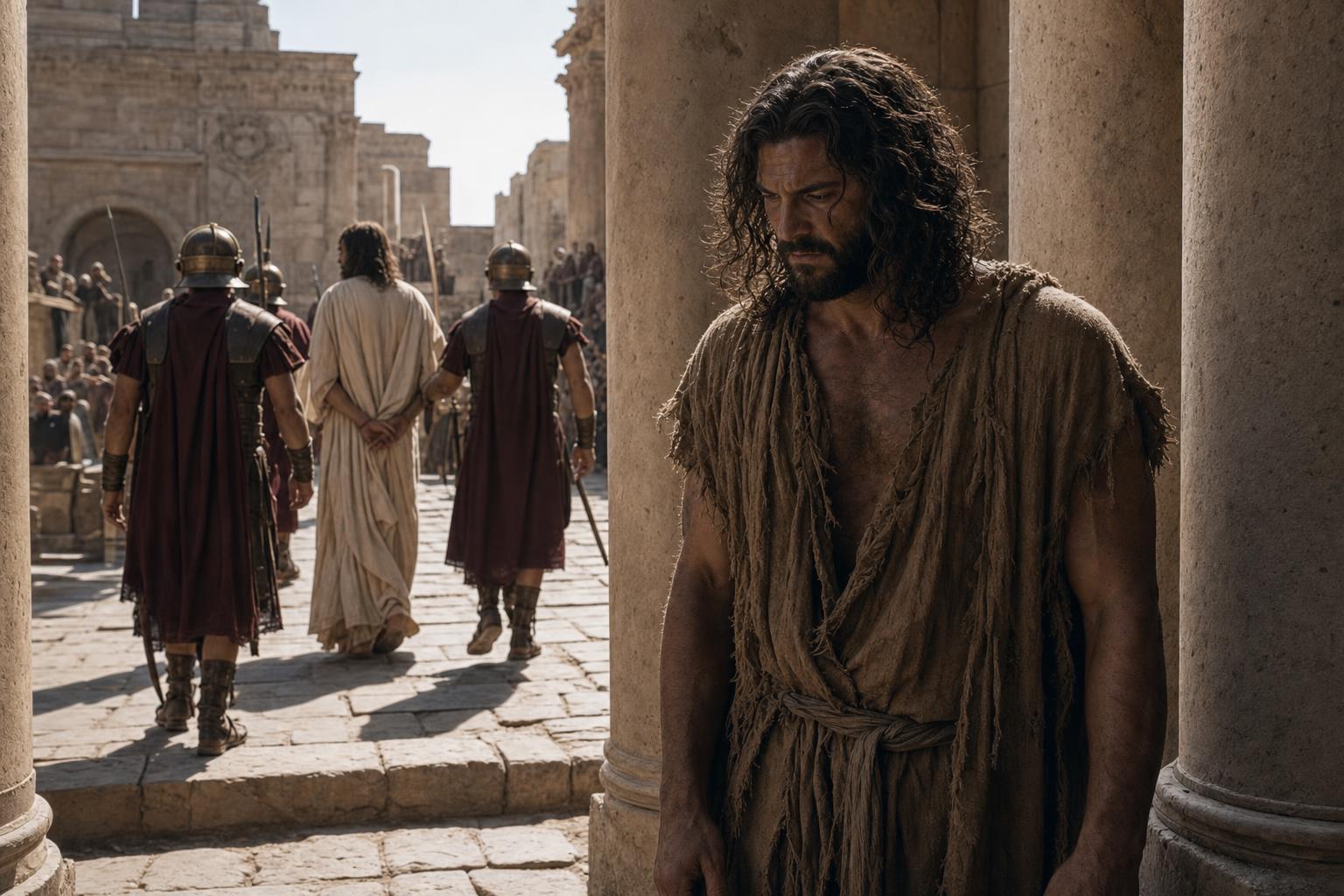
Barabbas steps out of prison while Jesus is led toward the cross. The place where Jesus was executed is remembered today in the story of where Jesus was crucified, but the contrast begins before that journey is complete. It begins with a guilty prisoner going free and an innocent Savior being condemned.
Key Bible passages about Barabbas
If you want to study Barabbas more closely, start with these passages:
- Matthew 27:15-26 - Pilate offers the crowd a choice between Jesus and Barabbas
- Mark 15:6-15 - Barabbas is described as being involved in insurrection and murder
- Luke 23:18-25 - the crowd demands Barabbas, and Pilate releases the man imprisoned for rebellion and murder
- John 18:39-40 - Barabbas is called a robber, with several translations showing the rebel / revolutionary nuance
- Acts 3:14 - Peter later says the people asked for a murderer to be released instead of Jesus
Barabbas appears only briefly in Scripture, but those verses are enough to show why the scene stays unforgettable.
A short prayer inspired by Barabbas' story
Lord, thank You for showing me, through this hard scene, how serious sin really is and how great Your mercy is. Keep me from choosing what is loud, proud, or violent over what is true and holy. Teach me to receive Your forgiveness with humility and to seek Your guidance with an honest heart. Help me remember what Jesus willingly bore so that guilty people could go free. In Jesus' name, amen.
Frequently asked questions about Barabbas
Was Barabbas called Jesus Barabbas?
Some manuscripts of Matthew 27:16-17 preserve the name "Jesus Barabbas," and a few modern translations still show that reading. Many other translations simply say "Barabbas." So it is best to treat "Jesus Barabbas" as a disputed manuscript detail, not as an undisputed fact every Bible translation presents the same way.
What happened to Barabbas after he was released?
The Bible does not say. Scripture never tells readers what Barabbas did after Pilate released him, so any detailed story about his later life is speculation rather than a clear biblical fact.

