
Who Is Nehemiah in the Bible? Role, Story, and Meaning
Nehemiah in the Bible was a Jewish court official who served as cupbearer to King Artaxerxes of Persia before becoming the leader who rebuilt Jerusalem's walls. His story in the book of Nehemiah also shows him as a prayerful reformer who helped guide God's people toward renewed obedience after the exile.
That means Nehemiah is remembered for more than construction work alone. Scripture presents him as a man whose grief over Jerusalem moved him to pray, ask boldly, lead wisely, and stay faithful under pressure.
Where does Nehemiah fit in the Bible story?
Nehemiah's story happens in the post-exile period, after some Israelites had already returned from Babylon but while Jerusalem was still vulnerable and spiritually fragile. His story comes after the first return under Zerubbabel and after Ezra's ministry, so he belongs to the later stage of Judah's restoration after exile. That setting helps explain why walls, worship, and covenant faithfulness all matter in his story.
The book opens in Susa, a Persian capital, not in Jerusalem itself. That setting shows Nehemiah began far from the city he would later help restore.
What was Nehemiah's role before he went to Jerusalem?
Before he ever rebuilt a wall, Nehemiah served as the king's cupbearer. That was not a small or ceremonial role. It placed him close to Artaxerxes and required unusual trust, which helps explain why the king listened when Nehemiah later asked for leave, protection, and supplies.
Nehemiah is not presented as a priest like Ezra or a prophet like Malachi. In Scripture, he is shown as a trusted court official whom God used for political, practical, and spiritual restoration. Later in the story he also functions as governor in Judah, but his influence begins with ordinary faithfulness in a secular position.
What moved Nehemiah to act?
Nehemiah 1 begins when he hears that Jerusalem's wall is broken down and its gates have been burned. Instead of rushing straight into strategy, he sits down, weeps, fasts, and prays. His prayer includes confession, covenant language, and a direct request for favor before the king.
The pattern is striking. Nehemiah does not start with public confidence or a polished plan. He starts with grief, repentance, and dependence on God.
When Artaxerxes notices Nehemiah's sadness in Nehemiah 2, Nehemiah speaks honestly, asks for permission to go to Jerusalem, and receives far more than travel approval. The king gives him letters for safe passage and timber for the gates and walls. The story presents this as providence, not just good politics.

What did Nehemiah do in Jerusalem?
After arriving in Jerusalem, Nehemiah quietly inspects the damage before rallying the people. In Nehemiah 2:17-20 he names the city's disgrace and calls the people to rise up and rebuild. The result is a private burden becoming public action.
The rebuilding itself is one of the most memorable parts of the story. Nehemiah organizes the people, answers the mockery of Sanballat, Tobiah, and Geshem, and keeps the work moving even when threats increase. Nehemiah 4 shows the builders staying ready to defend themselves while they work, which is why readers often remember the image of labor with one hand and vigilance with the other.
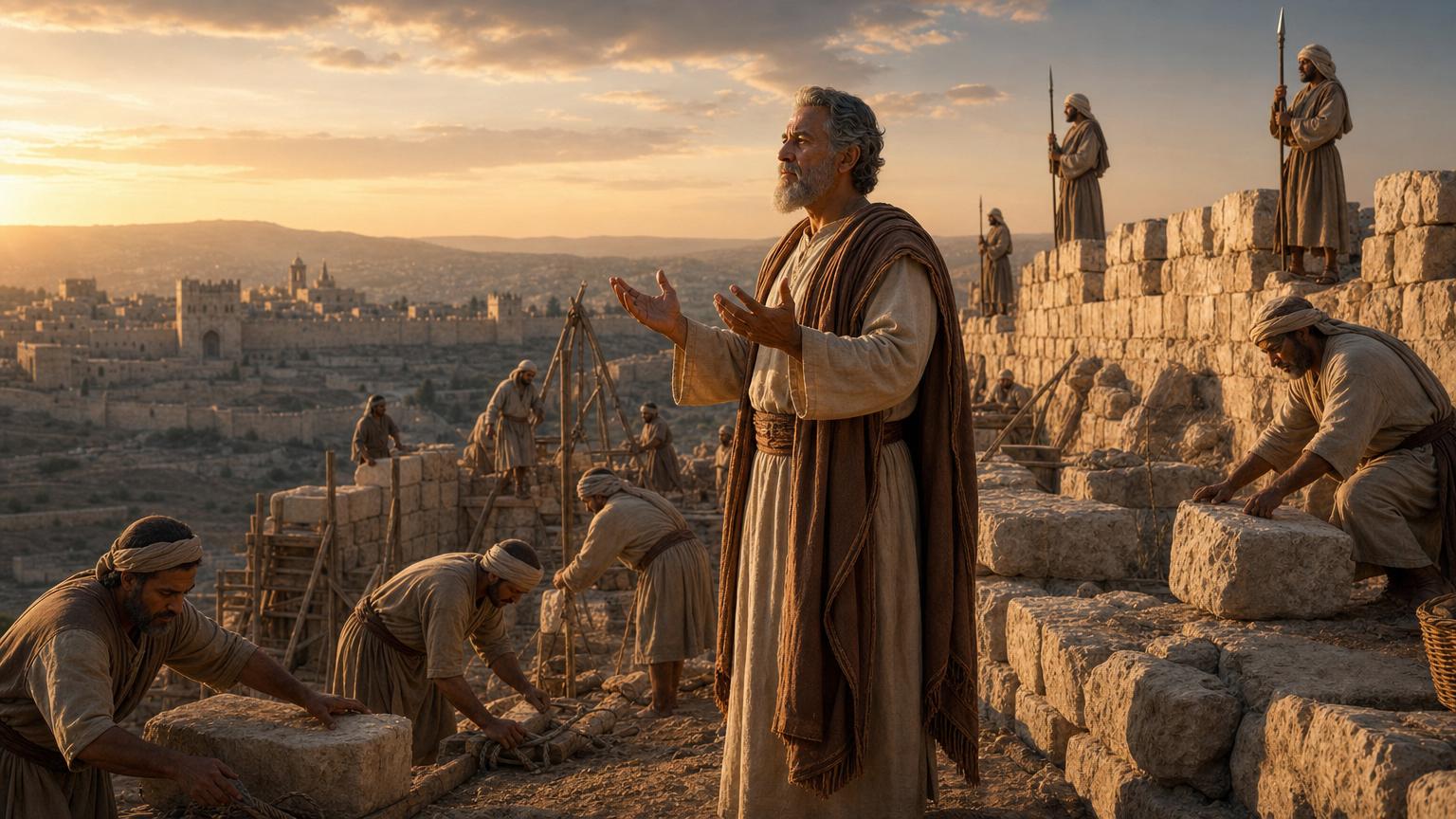
The wall is completed in fifty-two days according to Nehemiah 6:15-16. It matters because it shows both the scale of the work and the persistence required to finish it while opposition kept pressing in.
How did Nehemiah help lead spiritual renewal?
Nehemiah's work was never only about physical walls. After the rebuilding, the story turns toward worship, covenant, and reform. Nehemiah 8:1-8 describes Ezra reading the Book of the Law before the gathered people while others help them understand what is being read. That scene makes it clear that rebuilt structures were meant to support a renewed life with God.
This is also where Nehemiah connects most naturally with Ezra. Ezra's teaching ministry and Nehemiah's practical leadership work together in the larger restoration story.
The book does not end with an easy triumph, though. Nehemiah 13 shows that even after the wall is finished and the people renew the covenant, compromise returns and Nehemiah has to confront it. The tension remains: outward rebuilding and even sincere reform cannot completely solve the deeper problem of the human heart.
Why does Nehemiah matter in the Bible?
Nehemiah matters because he shows what prayerful courage looks like in real life. He cared enough about God's people to grieve. He trusted God enough to ask boldly. He worked carefully, answered opposition steadily, and kept going when pressure mounted.
That is also why many readers remember Nehemiah as a good leader. He prayed first, planned carefully, told the truth about the problem, and kept people focused on the work God had given them.
He also matters because his story is honest. Nehemiah is not remembered as a flawless hero who fixed everything forever. He is remembered as a faithful servant through whom God brought real help, even though the people still needed deeper renewal than policy and walls alone could provide.
For Christian readers today, Nehemiah is a strong picture of seeking God's help before acting and then taking the next obedient step. If you want to keep tracing that restoration story, Jeremiah helps explain why heart-level renewal was always needed after exile. And if Nehemiah's example stirs your own need for wisdom and courage, these prayers for guidance are a natural next step.
Key Bible passages about Nehemiah
If you want to study Nehemiah more closely, start with these passages:
- Nehemiah 1:4-11 - Nehemiah prays after hearing about Jerusalem's condition.
- Nehemiah 2:1-8 - Artaxerxes grants leave, letters, and supplies.
- Nehemiah 2:17-20 - Nehemiah rallies the people to rebuild.
- Nehemiah 4:14-23 - The people keep working despite active threats.
- Nehemiah 6:15-16 - The wall is completed in fifty-two days.
- Nehemiah 8:1-8 - Ezra reads the Law and the people understand it.
- Nehemiah 13:15-31 - Nehemiah confronts later compromise and disorder.
A short prayer inspired by Nehemiah
Lord, give me a heart that cares about what is broken and the courage to bring it to You first. Teach me to pray honestly, act wisely, and trust You for strength when the work is hard. Guard me from fear, pride, and discouragement. Make me faithful in the place You have given me, and help me take the next right step in obedience. In Jesus' name, amen.
Frequently asked questions
Was Nehemiah a prophet?
The Bible does not present Nehemiah primarily as a prophet. He is better understood as a Jewish leader, court official, and governor whom God used in a specific moment of restoration.
Was Nehemiah a priest or a king?
No. Nehemiah was not a priest like Ezra and he was not a king. He served Artaxerxes as cupbearer and later acted as governor in Judah.
Was Nehemiah a eunuch?
Some readers ask this because he served in a royal court, but the Bible does not explicitly say Nehemiah was a eunuch. It is better not to claim more than the text does.
How long did it take Nehemiah to rebuild the wall?
Nehemiah 6:15 says the wall was finished in fifty-two days.
Are Ezra and Nehemiah the same person?
No. Ezra and Nehemiah were different leaders who served in the same general restoration period. Ezra is especially tied to teaching God's law, while Nehemiah is especially tied to rebuilding Jerusalem's walls and governing the city.

