
Who Is Pharaoh in the Bible? Role in the Exodus
In the Bible, Pharaoh is not one man's personal name. It is the title used for the king of Egypt. That means Scripture can talk about more than one pharaoh across different events and generations, even when it does not give the ruler's personal name.
Most readers asking who is Pharaoh in the Bible are really asking about the ruler in Exodus - the king who oppressed Israel, refused Moses's request to let God's people go, and stood at the center of the ten plagues. That is the best-known Pharaoh in Scripture. But he is not the only one the Bible mentions.
Is Pharaoh a name or a title?
Pharaoh is a title for Egypt's ruler, much like saying king or emperor. So when the Bible says Pharaoh, it is usually identifying the ruler by office rather than by personal name.
That one point clears up a lot of confusion. It explains why the Bible can mention Pharaoh in Abraham's day, Pharaoh in Joseph's day, and Pharaoh in Moses's day without meaning the same person every time. It also explains why readers sometimes ask for the real name of Pharaoh and find that the biblical text itself does not always provide one.
So the shortest honest answer is this: Pharaoh in the Bible means the king of Egypt, and several different Egyptian rulers appear under that title.
Which Pharaoh do people usually mean in the Bible?
In practice, most people mean the Pharaoh in Moses's story.
That makes sense, because Exodus gives Pharaoh his biggest biblical role. He is the ruler who enslaves the Israelites, refuses repeated warnings, and becomes the main human opponent in the story of Israel's deliverance.
But Exodus is not the first time Scripture mentions an Egyptian ruler.
Earlier in Genesis, Joseph rises to power under a different Pharaoh after interpreting the king's dreams. That Pharaoh treats Joseph favorably and allows Jacob's family to settle in Egypt. If you want more background on that earlier part of the story, PrayersFor already has Bible verses about Joseph.
Later, Exodus opens with a new Egyptian king who does not honor Joseph's memory and begins to oppress Israel. So when readers ask about Pharaoh, the Bible's answer is broader than one man, but the search intent usually narrows to the ruler connected to Moses, the plagues, and the Red Sea.

What did the Pharaoh in Exodus do?
The Pharaoh in Exodus is the ruler who turns Israel's situation in Egypt into slavery and suffering.
Exodus begins with a Pharaoh who fears Israel's growth and forces the Hebrews into hard labor. He even orders Hebrew baby boys to be killed. That is why Moses' birth story begins under danger and hiding. If you want to read more around that moment, PrayersFor has Bible verses about Moses' birth.
Later, after Moses flees Midian and the king of Egypt dies, Moses returns with Aaron to confront the Pharaoh ruling at that point in the story. Readers often speak about the Pharaoh of Exodus across the whole narrative, even though the story itself may span more than one Egyptian ruler. The Pharaoh Moses confronts repeatedly refuses God's command: "Let my people go." He hardens his heart through the cycle of warnings and plagues. Water turns to blood. Frogs, gnats, flies, livestock death, boils, hail, locusts, darkness, and finally the death of the firstborn strike Egypt.
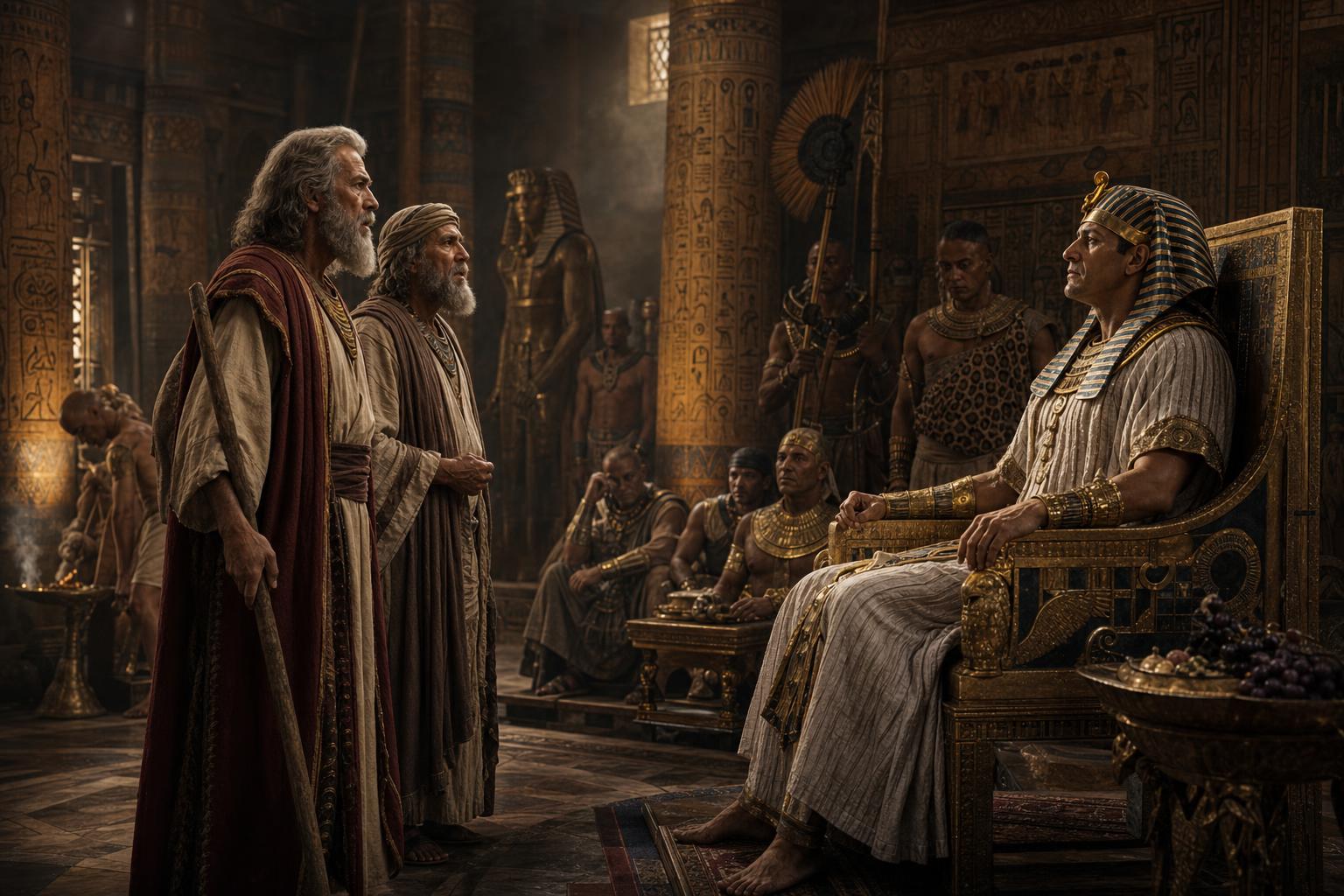
That part of the story is why so many readers connect Pharaoh with stubborn pride and resistance to God. Pharaoh is not only a political ruler in Exodus. He becomes the picture of a heart that keeps refusing the truth even after repeated warnings.
Several existing PrayersFor pages can deepen those parts of the story, including Bible verses about the plagues of Egypt, Passover, oppression, and Moses parting the Red Sea.
It is also worth noticing that the Exodus story covers more than a momentary disagreement. Pharaoh represents a whole system of power that uses fear, control, and force to keep people in bondage. That is why God's judgment on Pharaoh is not random anger. It is part of God's rescue of people who were being crushed.
Was the Pharaoh of Exodus ever named?
The Bible does not give the personal name of the Pharaoh Moses confronts.
That is one of the biggest reasons the question stays debated. Historians, archaeologists, and Bible interpreters have proposed different rulers over the years. Ramesses II is probably the most famous suggestion in popular culture. Others argue for rulers such as Amenhotep II or another king from a different timeline.
But Scripture itself does not settle that question for us. And for a page like this, that matters.
The safest and clearest answer is not to pretend certainty where the Bible leaves room for debate. The text tells readers what they most need to know: Pharaoh was the ruler of Egypt, he opposed God's command, he hardened his heart, and God delivered Israel anyway.
So if your question is "What was Pharaoh's actual name?", the biblical answer is simple: the Bible never says.
Other pharaohs mentioned in the Bible
Even though the Exodus ruler is the best-known Pharaoh in Scripture, he is not the only one.
Pharaoh in Abraham's story
In Genesis 12, Abram and Sarai go down to Egypt during famine. Pharaoh takes Sarai into his house after Abram says she is his sister, but God intervenes and Pharaoh sends them away.
Pharaoh in Joseph's story
In Genesis 41-47, Pharaoh dreams troubling dreams, Joseph interprets them, and Joseph is raised to a position of authority. This Pharaoh becomes part of the story of provision and survival during famine, very different from the ruler in Exodus.
Pharaoh in Moses's story
This is the Pharaoh most readers mean: the ruler tied to Israel's slavery, Moses' confrontation, the plagues, and the sea.
Later named Egyptian rulers
Later parts of the Old Testament do begin naming Egyptian rulers more directly. Pages tied to kings and prophets mention figures such as Shishak, Neco, and Hophra. That matters because it shows the Bible is fully capable of naming Egyptian rulers when it chooses to. The earlier Genesis and Exodus anonymity is not an accident readers should ignore.
So if someone asks, "How many pharaohs are in the Bible?", the better answer is not one exact number first. The better answer is: the Bible mentions several Egyptian rulers under the title Pharaoh, some unnamed and some later named.
What does Pharaoh represent spiritually in the Bible?
Pharaoh is a historical ruler in Scripture, but he is also more than that.
Spiritually, Pharaoh often represents:
- pride that refuses to bow before God
- power used to oppress other people
- a hardened heart that keeps resisting truth
- the false confidence that human authority can overrule God's command
That is one reason readers still return to Pharaoh's story. The question is not only "Who was he?" but also "What kind of heart did he have?"
Exodus shows that outward power is not the same as inward strength. Pharaoh had armies, wealth, and political control. But again and again, he stood on the wrong side of God's will. His story warns readers against stubbornness, self-exaltation, and the kind of power that crushes others.
At the same time, Pharaoh's story points to something hopeful: God is able to deliver His people even when the strongest earthly ruler says no. That is why the Exodus is not only a story about judgment. It is a story about rescue.
Key Bible passages about Pharaoh
If you want to trace Pharaoh through Scripture, these are strong starting places:
- Genesis 12:10-20 - Pharaoh in Abram and Sarai's story
- Genesis 41:1-46 - Pharaoh in Joseph's rise to power
- Exodus 1:8-22 - the ruler who begins Israel's oppression
- Exodus 5-14 - Moses confronts Pharaoh, the plagues, and the escape from Egypt
- 1 Kings 14:25 - Shishak attacks Jerusalem
- 2 Kings 23:29 - Pharaoh Neco appears in Josiah's story
- Jeremiah 44:30 - Pharaoh Hophra is named in prophecy
Taken together, these passages show both sides of the answer: Pharaoh is a broad biblical title for Egypt's rulers, but the ruler in Exodus is the figure most people mean when they ask about Pharaoh in the Bible.
Final thoughts on Pharaoh in the Bible
So, who is Pharaoh in the Bible?
The clearest answer is this: Pharaoh is the title for Egypt's king, not the personal name of one single man. Several pharaohs appear in Scripture, but the one most people mean is the ruler in Exodus who opposed Moses and refused to let Israel go.
The Bible never tells us that ruler's personal name. What it does tell us is more important than a guessed identity: Pharaoh stood for pride, oppression, and a hardened heart, and God still proved stronger.
That is why Pharaoh matters in the Bible. He is not only part of Israel's history. He is also part of the Bible's larger message that no throne, no ruler, and no hardened heart can finally stand above the Lord.

